The meteorological radiosonde is an interesting creature. It sets off from somewhere beneath a large white balloon, measures the atmosphere’s temperature, humidity, pressure and GPS coordinates, and then, when the balloon bursts, the instrument descends to the ground. For meteorologists, the story more or less ends here; for radio amateurs and radiosonde hunters, however, this is where the more exciting part begins: it has to be found and recovered. Which is sometimes harder than one might think…
Finding it is sometimes simple. The sonde is lying there in the field, with the string, the parachute and the remains of the balloon beside it. It can be seen from a distance; all you have to do is pick it up. At other times, however, nature decides to hang the sonde in the crown of a tree, in a thicket, or on a snow guard on a roof. The sonde is up there; as long as its signals can be received it is not difficult to locate, and it can even be seen — it just cannot be reached.
This is the moment when the radiosonde hunter starts staring at the tree for a long time, and then at what fishing shops have to offer.
It Is Not the Sonde You Need to Reach, but the Line
A radiosonde usually does not get caught by itself; rather, the line, parachute or balloon remnant attached to it wraps around something. The instrument is often just hanging there. Sometimes it could be pulled down fairly easily; at other times it can only be recovered by cutting the line.
There is no need — and it is not advisable — to climb up. A good carbon-fibre telescopic fishing rod is light, not too expensive, can be extended to a long reach, and is easy to transport when collapsed. All you need is something at the end of the rod that can cut the line.
A cutting head that can be attached to a fishing rod is not difficult to make with 3D printing. It is important for it to be small and light; otherwise the end of the rod bends badly. Tying a Swiss Army knife to the end is not worth trying: it will not work, though it can accidentally be thrown surprisingly far that way. If the head is too heavy, the rod bends, trembles, becomes inaccurate, and instead of cutting, you will simply be waving it around.
The Basic Idea: Hook and Blade
The simplest working solution is a small hook with a blade. The hook is used to catch the radiosonde’s line; you can gently try to pull the thing down without cutting the line, and if that does not work, you can cut the sonde down with the blade.
A piece of advice: if you try to tug it down from a tree, do not pull continuously like a horse in harness. Instead, jerk it gently: pull it 0.5–1 metre, as much as it allows, then let it slacken, and pull again. This may free the line from small twigs, and after a while the sonde may slide down by itself.
If it does not come down, then comes the blade and the cutting. You should not hack with the blade, but pull it. A hooked utility blade — the kind used for cutting carpet, linoleum and cardboard — is very sharp, and will cut the line with one firm, not too forceful pull.
A replaceable blade is practical, because synthetic line, soil, tree branches and rust together can damage the cutting edge surprisingly quickly.
The 3D-Printed Tool
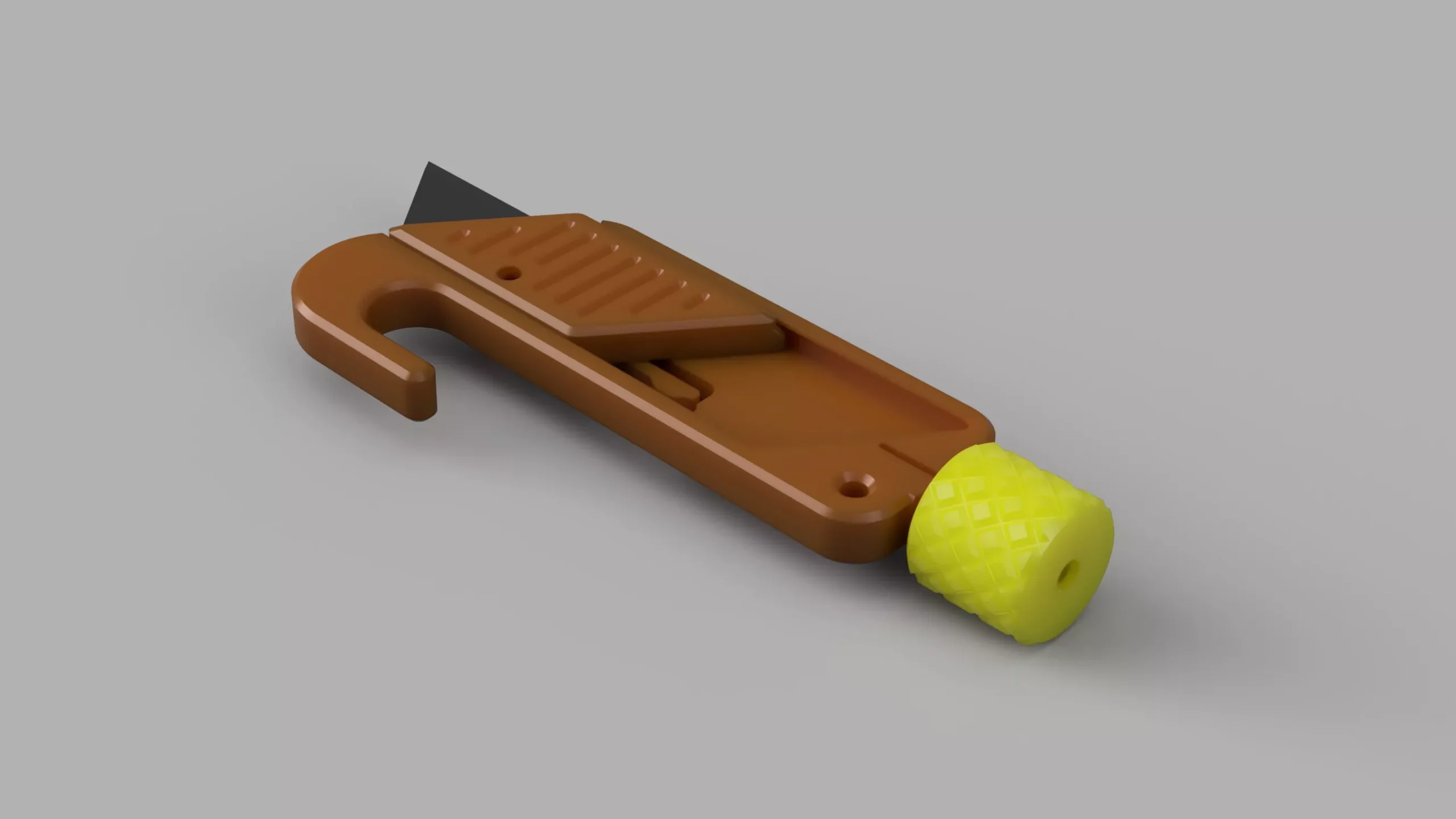
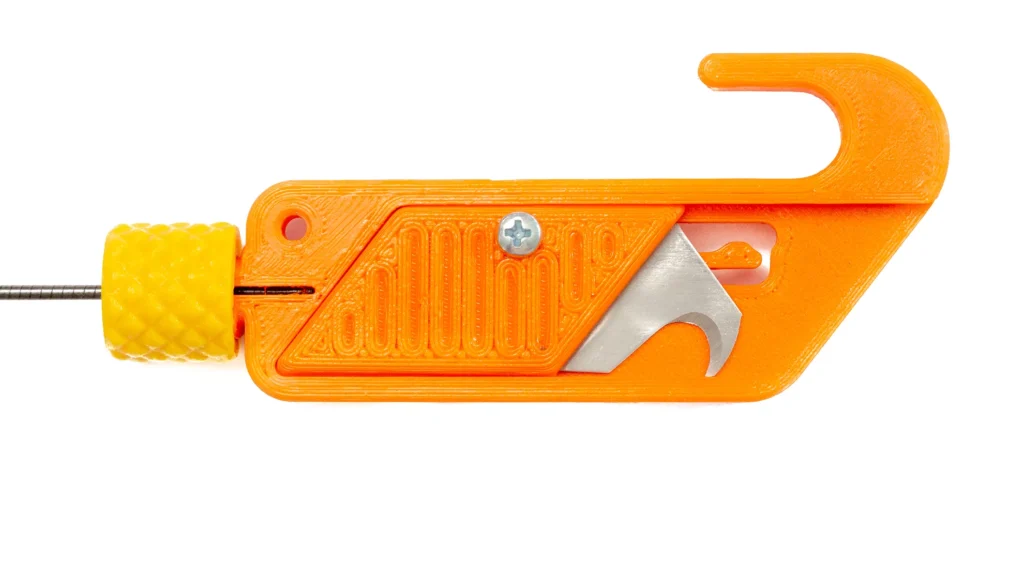
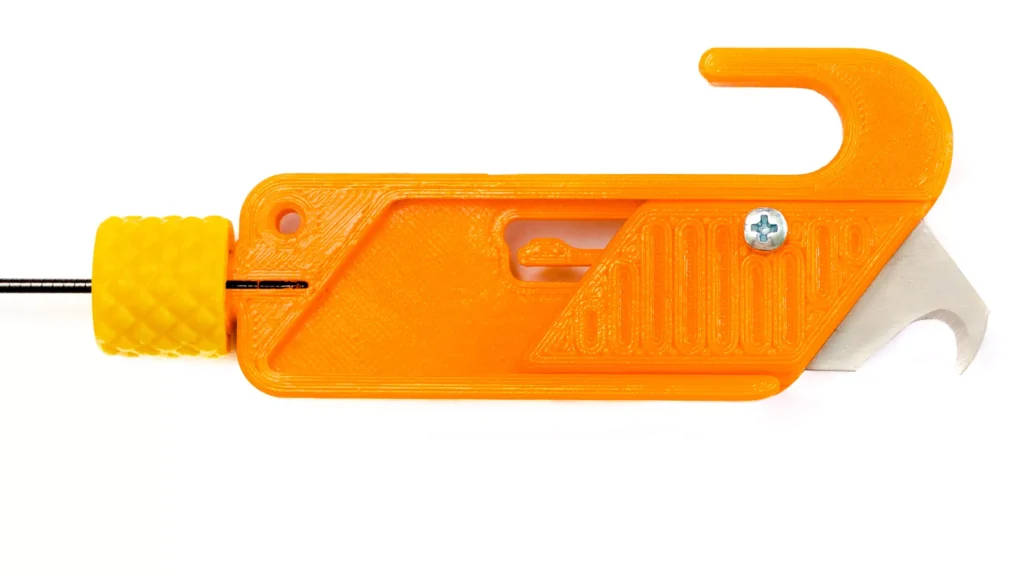
The tool shown in the picture is a 3D-printed cutting head designed specifically for radiosonde hunting. Its body is made of orange ABS plastic. It is conspicuous, light, and large enough not to disappear immediately in grass, leaf litter or outdoor terrain.
It has a hook for pulling or adjusting the radiosonde’s line, parachute or balloon remnants. It also has a hooked utility blade for cutting. The blade is held in place by an M3 screw, which also serves as the pivot pin of the locking mechanism. The blade clicks into two positions: retracted for transport or hooking, and extended for cutting.
The ends of fishing rods usually have no mounting point at all, only the bare carbon-fibre tip, about ∅1.5–2 mm in diameter. That is why I designed a screw-tightened, tapered, chuck-like clamp for it. You simply push it onto the tip and tighten the screw, and it clamps firmly onto the end of the rod.
The small hole in the body is not decoration either: a string can be tied to it. The string can serve as a safety tether if we are not sure that the head sits tightly enough on the end of the rod not to fall off. It can also be used for control if, for example in windy weather, we cannot easily hit the sonde. And a loop can also be tied there, with which the object can be caught.
Safety First!
A sharp blade mounted on the end of a long rod is a dangerous tool. It must not be used near people, animals, wires, cars or greenhouses. The blade must be secured very safely, because if it falls, it can cause serious injury — for example if the telescopic rod accidentally collapses because one of its sections was not tightened properly.
A carbon-fibre fishing rod conducts electricity extremely well. It must not be used near electrical transmission lines, within a radius of 30 metres. It can cause a fatal electric shock. It does not even have to touch the wire: because of electric field concentration at the tip, a high-voltage transmission line can arc over from several metres away, and if you are at the other end of the rod, your family will receive what remains of you in a small box of ashes. The tool must also not be used in stormy weather, because it can act as a lightning rod.
If the sonde or the line is caught on an electrical wire, it must not be touched. This is not “a little dangerous”; it is clearly in the forbidden category. The line is plastic and theoretically does not conduct electricity, but in practice it may be wet — after all, it may have been among the clouds not long before — and then it is dangerous. If we find something like this, we should call the electricity provider and report it. The find is still yours; they may even give you the sonde after they have removed it professionally. And you can also be glad that you did not become an instructive newspaper story.
The radiosonde is light, but if it falls from a height of 7–8 metres, it can still hit hard. It can be unpleasant if it lands on someone’s head. Before cutting it down, it is worth checking where the device will fall. The antenna and the temperature probe protrude from the sonde, and these can cause serious eye injuries if they hit you. In addition, all kinds of debris, twigs and pieces of bark can fall from the tree. For this reason, safety glasses are a good idea.
Law and Common Sense
Radiosonde hunting is not only a technical matter. We do not enter private property without permission. We do not climb over fences. We do not damage crops, trees, birds’ nests, roofs or wires. If the sonde is in a place where removing it would cause damage or danger, then we do not remove it.
Radiosonde hunting is a fine hobby because it combines radio technology, meteorology, map reading and field problem-solving. But a good story is not made by recovering the instrument at all costs. Sometimes the best decision is simply to photograph it, record the location, and accept that this time the tree has won.
Summary
A radiosonde cutting tool that can be mounted on a fishing rod is simple and brilliant. It does not require complicated electronics, a microcontroller or artificial intelligence. What it needs is a light rod, a blade, a 3D printer and a little patience. And if everything goes well, the sonde comes down, the rod remains intact, the tree is not damaged, no one falls into a ditch, and another small white box appears on the workbench — one that once travelled up there in the stratosphere. That alone is a good enough reason to occasionally mount strange things on the end of a fishing rod.
The STL files required for 3D printing can be downloaded here: https://www.printables.com/model/1701737-pole-mounted-radiosonde-line-cutter